EHCPs aren't changing yet: what the SEND reforms mean for your family right now
The Government has proposed big changes to EHC plans. Here's what's proposed, what hasn't changed, and what you can still do today, in plain English.
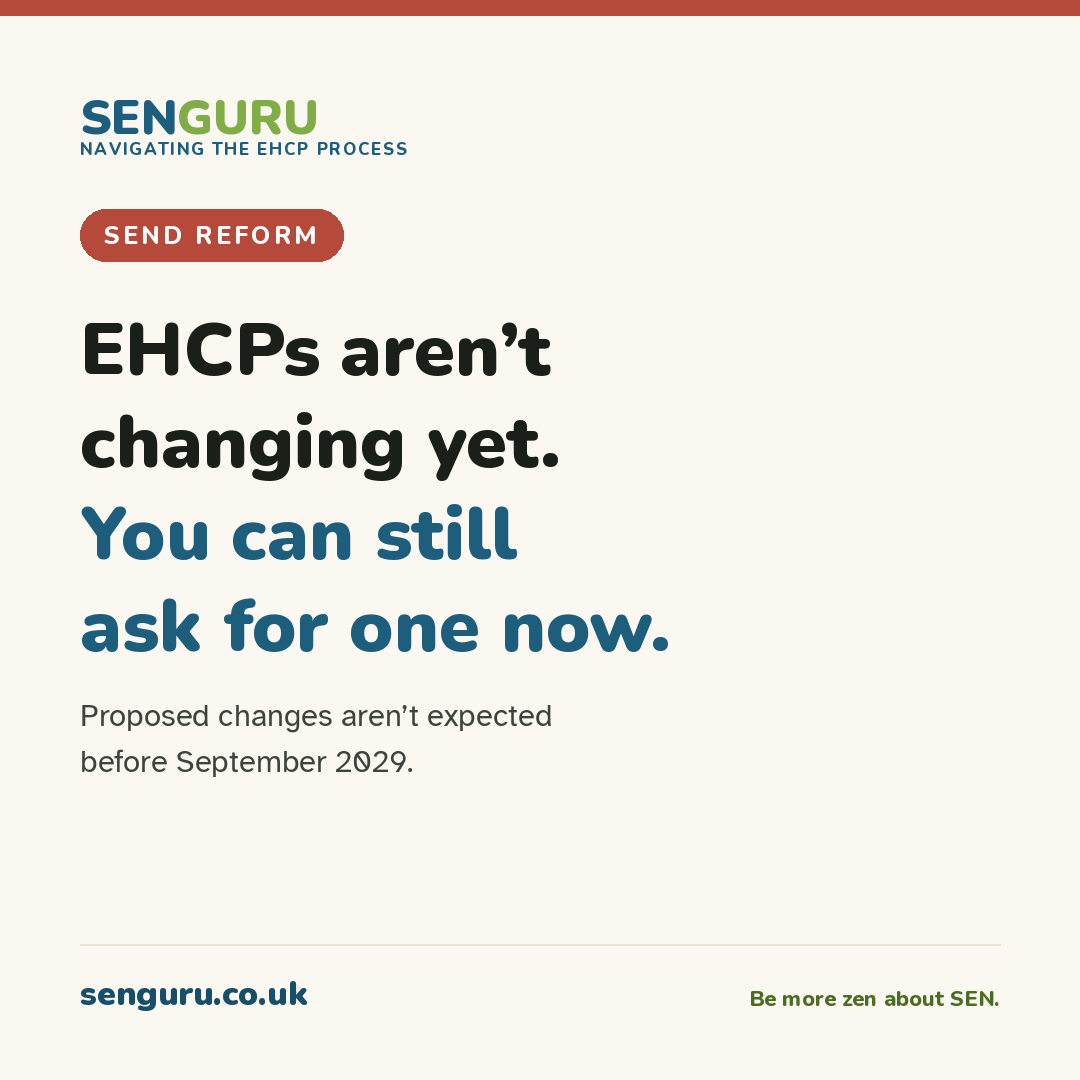
If you’ve seen headlines about EHCPs “being scrapped” or “taken away”, you’re not alone in feeling worried. This post explains what has actually been proposed, what hasn’t changed, and what you can still do now.
First, what is an EHCP?
An EHCP (Education, Health and Care Plan) is a legal document from your local council. It sets out your child’s special educational needs and the support they must get to meet them.
The most important word there is must. Once support is written into Section F of the plan, the council has a legal duty to make sure it is provided (Children and Families Act 2014, section 42). That legal guarantee is what makes an EHCP different from the support a school offers on its own.
What has the Government proposed?
In February 2026 the Government published a Schools White Paper, Every Child Achieving and Thriving, alongside a consultation on SEND reform (House of Commons Library). In summary:
- New EHCPs would be for children with the most complex needs. They would be linked to new “Specialist Provision Packages” (Farrer & Co summary).
- Every child with SEND would get an Individual Support Plan (ISP), written by their school or setting and reviewed with parents at least once a year (House of Commons Library; Farrer & Co).
- Children who already have an EHCP would be reassessed at key points, such as moving school, once the new system starts (Farrer & Co).
The consultation closed on 18 May 2026. At the time of writing, the Government has not published its response (House of Commons Library).
What hasn’t changed
Nothing has changed in law yet. These are proposals. The reformed system needs new legislation and is not expected to take effect until September 2029. The Government has also said that support provided through existing EHCPs will not change before at least September 2030 (House of Commons Library).
Until then, the current law applies in full. That means:
- You can ask for an EHC needs assessment yourself. You don’t need the school’s permission (section 36(1)).
- The test is “may”, not “must”. The council must assess if your child may have special educational needs and it may be necessary for support to be provided through an EHCP (section 36(8)).
- There are deadlines. The council must tell you within 6 weeks whether it will assess, and the whole process, from request to final plan, should take no more than 20 weeks (SEND Regulations 2014, regulation 5 and regulation 13).
- You can appeal. If the council refuses to assess, or you disagree with what’s in the plan, you can appeal to the First-tier Tribunal (SEND) (section 51).
Why this matters
The current system is under real strain:
- 718,838 children and young people had an EHCP in January 2026, up 12.5% in a year (Department for Education).
- Only 46.1% of new plans in 2025 were issued within the 20-week legal limit (DfE).
- 26.6% of requests for an assessment were refused in 2025 (DfE).
The legal guarantee also seems to make a difference to families. In a Government-funded study of 13 to 14-year-olds in mainstream schools, 73% of parents of children with an EHCP said the school supported their child well across all their needs, compared with 54% of parents of children without one (SEND Futures, NatCen for DfE, 2024).
What you can do now
- If you think your child needs more support than school can give, don’t wait. You can request an assessment today under the current law.
- Put everything in writing and keep dated copies of every letter, email and report.
- Keep a log of what you see at home and what the school tells you. It becomes your evidence.
- Get free, expert advice about your own situation from IPSEA, SOS!SEN, Contact or your local SENDIASS.
How SENguru can help
SENguru is a community interest company founded by two SEND parents. We’re building free, secure tools to help families through the EHC process: a correspondence tracker, a behaviour and communication log, a plain-English guide with deadline tracking, and EHC plan draft review.
We’re in closed beta now, and the free version is planned to open to all families in early 2027. Join the waitlist at senguru.co.uk.
This post is general information, not legal advice. For advice on your situation, contact IPSEA or SOS!SEN.